Livin' La Vida Luna y Luca

6 and 4 is the perfect age to bring kids to Baha Mar. Just remember to say they're 5 and 4, so they can both eat for free. 😂
Supercommunicators 📖
Charles Duhigg recently made a guest appearance on one of my favorite podcasts, My First Million.
Charles Duhigg on MFM
For anyone who doesn't know, Charles wrote The Power of Habit ~5 years before James Clear broke through the zeitgeist with Atomic Habits.
Charles' most recent book is called Supercommunicators, and since I'm currently obsessed with the idea of creating slippery slopes with potential sellers, I just had to read it.
Here's what I gathered after ripping through the book in a few nights.
Disclaimer: Everything you're about to read seems so obvious on the surface. This is not contrarian advice. It's less about learning new methods of communication. It's more about reminding yourself of the basics and applying them tactfully to improve results.
The Three Types of Conversations:
- What's this really about? Practical convo
- What do we all need?
- How will we speak and make decisions?
- How do we feel? Emotional convo
- Who are we? Identity convo
Miscommunication occurs when people simultaneously have different kinds of conversations. If you are speaking emotionally, while I’m talking practically, we are, in essence, using different cognitive languages.
- i.e. Dia complains about someone at work (emotional), and I respond with potential solutions (practical), it can end up in an argument.
- Happy couples communicate agreement not with the speaker’s point of view or content, but with the speaker’s affect. Happy couples ask each other more questions, repeat what the other person said, make tension-easing jokes, get serious together.
- Simply asking, "Do you want to be helped, hugged, or heard?" is a simple prompt to ensure your reply aligns with the type of conversation your counterpart is seeking.
The Learning Conversation:
- Rule 1: Identify which type of conversation is happening
- Rule 2: Share your goals + ask what others are seeking
- Rule 3: Share your feelings + ask what others are feeling
- Rule 4: Share your identity + ask about their identity
How this applies to my business:
- Rule 1: Are we having an emotional or practical conversation about your home? Some sellers are reluctant to move because of the memories created in their home. That's an emotional conversation. Some sellers want to see top dollar and want to leave everything, including the memories, behind. That's a practical conversation.
- Rule 2: I'd like to come to a fair agreement on price and offer you the best terms possible for your particular situation, and in return, I'd like a firm commitment from you to move forward with me. Does that align with what you want?
- Rule 3: I'm excited about the prospect of doing business together. I will ensure a smooth transition from this home to your next. I won't rush you out, I won't delay on my commitments, and we'll go at your pace. How does that sound to you?
- Rule 4: My word is my bond, and I fully intend on over-delivering. You also seem like someone who stands behind your word. Are we on the same boat?

Never start a negotiation by assuming you know what the other side wants.
Negotiations are not zero-sum games. You can almost always expand the pie. i.e. When buying a property, focusing on price is a zero-sum game. I like to expand the pie by offering additional terms like paying for their attorney, transfer taxes, or relocation costs. Or I offer them a flexible closing timeline. Or I offer them a free 30-day use & occupancy agreement to stay in the home after I buy it. Great negotiators are creative artists.
Be Prepared:
Simply preparing a list of what you want to say can make a conversation go better:
- What are two topics you might discuss?
- What is one thing you hope to say?
- What is one question you will ask?
How this applies to my business:
Anytime I meet a new seller, I try to enter the conversation with a few canned replies. For example:
- An answer to "How are you?" that's better than "Good, thanks." I share a recent development or story that ultimately turns into a small conversation. "I went to the dentist this morning, and she said no cavities this time." or "I ran 3 miles this morning, so I'll definitely hit my 10,000 steps today."
- Comps! I like to arrive a few minutes early so I can quickly browse Zillow to remember the addresses I want to cite as comps for when we start talking about price. Knowing the neighborhood better than the seller is important.
- I like to ask ?'s like: What did you like about living here? Where are your kids now? How soon are you looking to make a decision? Where will you go next?
Asking Questions:
Questions about values, beliefs, judgments, and experiences are extremely powerful - and easier to ask than we think.
- Ask about someone’s beliefs or values
- How’d you decide to become a teacher?
- Ask someone to make a judgment
- Are you glad you went to law school?
- Ask about someone’s experiences
- What was it like to visit Europe?
Perspective Taking: try to see a situation from the other person’s perspective and show them we empathize.
Perspective Getting: ask people to describe their inner lives, their values and beliefs and feelings, the things they care about most.
Fast Friend Procedure: 36 Questions that lead to love. The protocol only works if you take turns answering each question.
Ask about feelings, not facts: Fact-based questions lead to dead-end answers. Feeling-based questions are a window to someone's preferences, values, and beliefs.
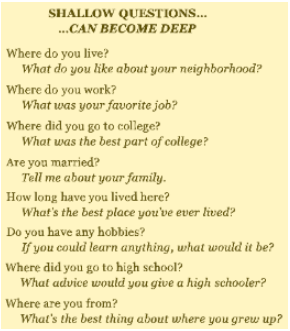
Fact-based questions are dead ends. Feeling-based questions act as a window to someone's preferences, beliefs, & values.
Looping for understanding: we need to prove, once a person has stopped speaking, that we have absorbed what they said. And the best way to do that is by repeating, in our own words, what we just heard them say—and then asking if we got it right.
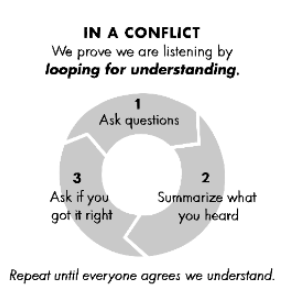
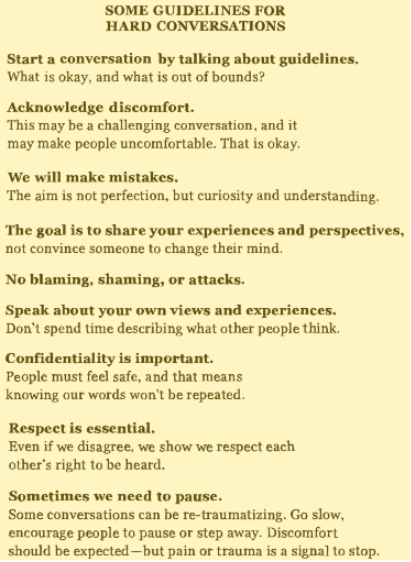
Participants crave control when in conflict. They might say, "Stop talking!" or "I'm done with this conversation."
Rather than trying to control the other person, productive conversationalists tend to focus, instead, on controlling themselves, their environment, and the conflict itself.
- Take breaks when feeling overwhelmed
- Write things down instead of shouting them
- Speak slowly and carefully
- Consider your environment - discuss in private vs. in public
- Set boundaries - discuss the topic, not the kitchen sink
Social Identities:
Social identities, as one psychology textbook explains, are “that part of our self-concept that comes from our membership in social groups, the value we place on this membership, and what it means to us emotionally.” Our social identities emerge from a blend of influences: The pride or defensiveness we feel based on the friends we’ve chosen, the schools we’ve attended, the workplaces we’ve joined. It’s the obligations we feel because of our family legacies, how we grew up, or where we worship.
We all possess numerous social identities—Democrat/Republican, Christian/Muslim, Black/white, self-made millionaire/working-class—that intersect in complicated ways. These identities nudge us and others to make assumptions. They can subtly cause us to “exaggerate the differences between groups” and overemphasize “the similarities of things in the same group."
You’ll never succeed at getting someone to change their behavior “if, as a prerequisite, you force them to say: Everything I’ve believed until now is wrong,”
📚
✌🏽&❤️