Livin' La Vida Luna y Luca

Our flight got delayed, so they decided to post up on the window sill. This could be the album cover of their childhood so far.
Made in America
Until recently, I had a bad streak with book selection. I couldn't get past the first few chapters of 3 books in a row.
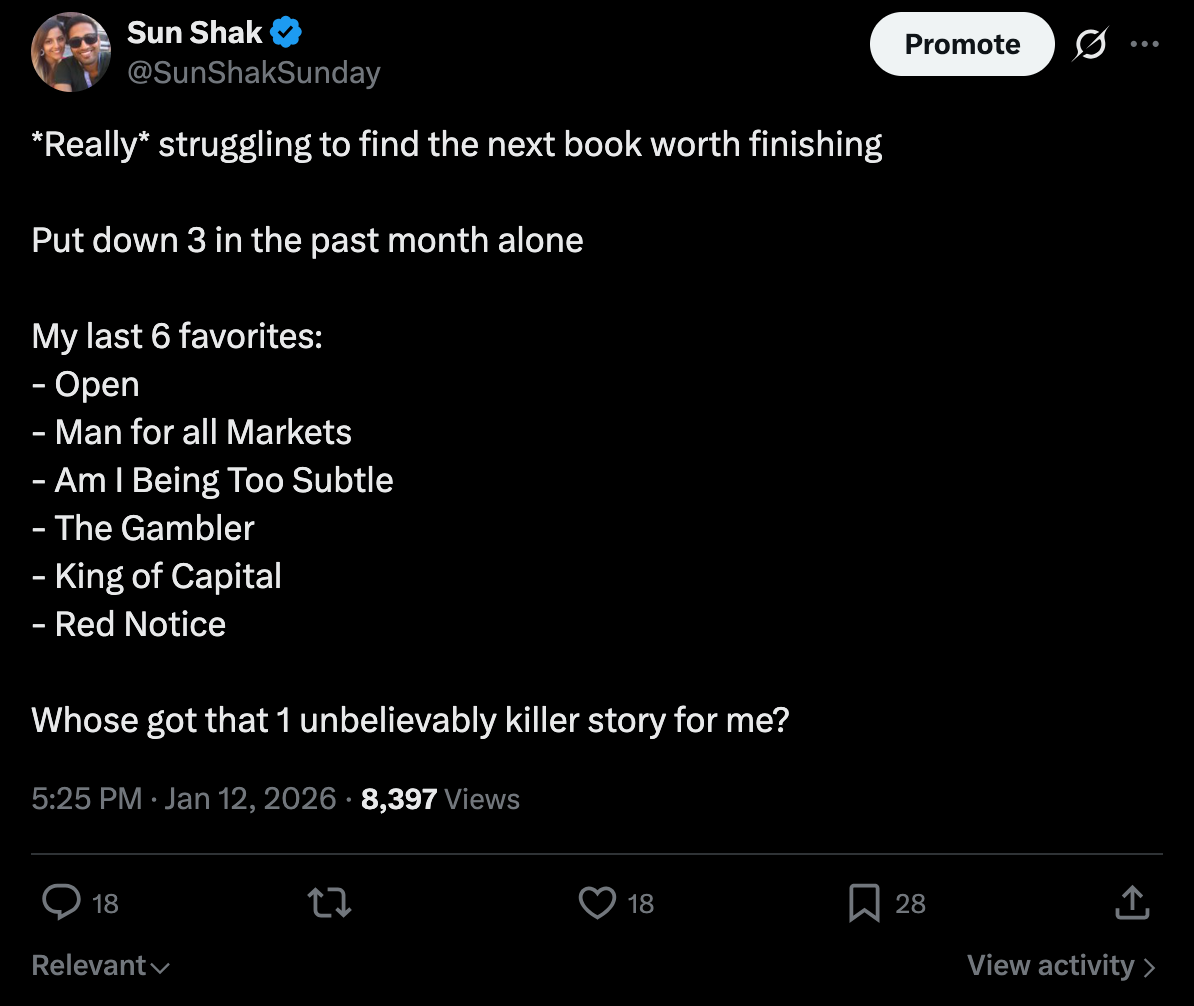
I posted my problem on X, and the comments section didn't disappoint.
A few people mentioned Made in America by Sam Walton as a must-read. It lived up to the expectation.
Here are my highlights and knee-jerk reactions to each:
- I had paper routes from the seventh grade all the way through college. I raised and sold rabbits and pigeons too, nothing really unusual for country boys of that era. I learned from a very early age that it was important for us kids to help provide for the home, to be contributors rather than just takers. In the process, of course, we learned how much hard work it took to get your hands on a dollar, and that when you did it was worth something.
Sam’s entrepreneurial tendencies started at a young age, which I believe is a common theme among most business owners. It was a paper route in the mid-to-late 1900s. That turned into selling candy at school, hawking Girl Scout cookies, or a lemonade stand on a hot summer day. For me, it was flipping and selling stuff on eBay.
- The best way to reduce paying estate taxes is to give your assets away before they appreciate.
The Walton’s are one of the wealthiest families in the world. Although it seems like most of them worked in the family business and actually "earned" their shares, this quote reminds me of an idea I read in a book called Die With Zero: give your children their inheritance when they’re 30. The argument for doing so is simple: they’ll need it more at that point (kids, down payments, student loans, etc.) than when you pass away, even though the absolute amount of money would likely be much, much less.
- I learned early on that one of the secrets to campus leadership was the simplest thing of all: speak to people coming down the sidewalk before they speak to you. I did that in college. I did it when I carried my papers. I would always look ahead and speak to the person coming toward me. If I knew them, I would call them by name, but even if I didn’t I would still speak to them. Before long, I probably knew more students than anybody in the university, and they recognized me and considered me their friend.
I can’t remember who said it, but I heard this “challenge” on a podcast once: Be Someone Who Goes First. When you lock eyes with someone in passing, smile first. When you enter a room, say “Hi” first. When meeting someone, stick your hand out first. I’ve tried to live by this since hearing it, and I’m even trying to instill it into my children. Luna adopted it quickly. Luca still needs some encouragement.
- Then I went somewhere to look at what Sterling Stores was doing—most everything I’ve done I’ve copied from somebody else—and saw these all-metal fixtures.
Walton owned & operated various discount stores long before he opened his first Wal-Mart. He would travel far and wide to visit other discount stores with a voice recorder and yellow legal pad in hand. This activity is known as “comp shopping” and it’s not limited to the retail industry. We do it as real estate developers as well, and that’s why most new homes you’ve seen for the past ~decade have been modern farmhouses (white with black accents).
- This is a big contradiction in my makeup that I don’t completely understand to this day. In many of my core values—things like church and family and civic leadership and even politics—I’m a pretty conservative guy. But for some reason in business, I have always been driven to buck the system, to innovate, to take things beyond where they’ve been. On the one hand, in the community, I really am an establishment kind of guy; on the other hand, in the marketplace, I have always been a maverick who enjoys shaking things up and creating a little anarchy.
This contradiction between his personality at home and at work doesn’t surprise me at all. It reminds me of the Ari Gold archetype: the guy who's meek at home, but an agent of chaos at work. I’ve pretty much nailed the home part, but could afford to become more brazen at work.
- I usually felt that if a fellow could manage his own finances, he would be more successful managing one of our stores.
No notes. I find people who pay close attention to improving their personal finance situation tend to have many other things in order as well. I'm well aware this is confirmation bias, but I'm sticking to it.
- Another one I learned a lot from was Sol Price, a great operator who had started Fed-Mart out in southern California in 1955. I made friends with Sol’s son-in-law, who was running a distribution center in Houston, and talking with him helped me sort out some of my thinking on distribution—which would eventually become another key to Wal-Mart’s success. I guess I’ve stolen—I actually prefer the word “borrowed”—as many ideas from Sol Price as from anybody else in the business.
I wasn't surprised at all to see Sol Price's name mentioned more than a few times in this book. Sol is the founder of Price Club and basically influenced every discount store we know today (including warehouses like Costco and Sam's Club). Listen to Acquired's episode on Costco to learn more about Sol.
- It’s true enough that I was nervous about spending any unnecessary money in those days. We were generating as much financing for growth as we could from the profits of the stores, but we were also borrowing everything we could. I was taking on a lot of personal debt to grow the company—it approached $ 2 million, which was a lot of money at the time. The debt was beginning to weigh on me.
This one hit me right in the feels. The growth stage of a capital-intensive business is...difficult. You try to do as much as you can with profits, but at the end of the day, you likely need to borrow money or sell pieces of the company to fund growth.
- From the time I took out my first bank loan—the $ 1,800 to buy that ice cream machine for the Ben Franklin down in Newport—I was never really comfortable with debt. But I recognized it as a necessity of doing business, and I had gotten pretty good at accumulating it. For a while, I would just go down to the local bank and borrow whatever I could to build a store or buy something we needed to grow the business. That practice had gotten me in debt to practically every bank in Arkansas and southern Missouri. They believed in what we had done up to that point, and they believed we would pay them off. I always did pay them off on time, but sometimes I would borrow from one to pay the other. I had bought a bank in Bentonville, for about $ 300,000, just a little old bank with only about $ 3.5 million in deposits. But it really helped me learn a lot about financing things. I made some new acquaintances and began to study more about bankers and how they liked to do business.
... Maybe I should buy a bank? 🤔🤔🤔
- Helen’s right, of course, about the downside of taking the company public. It did end up bringing us a lot of unwanted attention. But coming back from New York that day, I experienced one of the greatest feelings of my life, knowing that all our debts were paid off. The Walton family only owned 61 percent of Wal-Mart after that day, but we were able to pay off all those bankers, and from that day on, we haven’t borrowed one dime personally to support Wal-Mart. The company has rolled along on its own and financed itself.
Does anyone know how to take a single-family home development business public? 😅
- He’d make them an assistant manager. They were the ones who would go around and open all the new stores, and they would be next in line to manage their own store. In my opinion, most of them weren’t anywhere near ready to run stores, but Sam proved me wrong there. He finally convinced me. If you take someone who lacks the experience and the know-how but has the real desire and the willingness to work his tail off to get the job done, he’ll make up for what he lacks. And that proved true nine times out of ten. It was one way we were able to grow so fast.”
We talk about "GWC" in my accountability group when evaluating new hires. Does the person get it? Do they want it? And do they have the Capacity to do it? We came to the same conclusion as Sam: Wanting it is the most important of the three.
- What has carried this company so far so fast is the relationship that we, the managers, have been able to enjoy with our associates. By “associates” we mean those employees out in the stores and in the distribution centers and on the trucks who generally earn an hourly wage for all their hard work.
- The larger truth that I failed to see turned out to be another of those paradoxes—like the discounters’ principle of the less you charge, the more you’ll earn. And here it is: the more you share profits with your associates—whether it’s in salaries or incentives or bonuses or stock discounts—the more profit will accrue to the company. Why? Because the way management treats the associates is exactly how the associates will then treat the customers.
- I learned this early on in the variety store business: you’ve got to give folks responsibility, you’ve got to trust them, and then you’ve got to check on them.
Another important ingredient that has been in the Wal-Mart partnership from the very beginning has been our very unusual willingness to share most of the numbers of our business with all the associates. It’s the only way they can possibly do their jobs to the best of their abilities—to know what’s going on in their business. If I was a little slow to pick up on sharing the profits, we were among the first in our industry—and are still way out front of almost everybody—with the idea of empowering our associates by running the business practically as an open book. I’ve always told people in the stores what was going on with the numbers. But after we decided to act like a partnership, we formalized the sharing of information to a much greater degree.
I'm a one-man show with a virtual assistant, so I can't say much about building a company with millions(!) of employees. But Walmart just became the 1st Retailer to break $1T market cap, so I'll take Sam's word on how to build partnerships with your people.
- This is a highly competitive business, and an even more competitive company. It naturally attracts a lot of ambitious people, sometimes with egos to match. Ever since my peewee football days, I’ve believed almost any kind of competition is great. I expect our folks to compete with one another, and as I have said, what I hate is to see a rivalry become a personal thing, where the folks don’t support one another.
I loved this one because Sam mentioned many relationships with Founders of other discount retailers, and it seemed like there was a mutual respect between many of them, despite the healthy competition they shared. I love to hear that because I'm not much different. I'm friends with many single family home developers in my market, and I enjoy seeing them win about as much as I enjoy winning. There's enough to go around for all of us.
- 6 Principles
- Think One Store at a Time
- Communicate, Communicate, Communicate
- Keep Your Ear to the Ground
- Push Responsibility & Authority Down
- Force Ideas to Bubble Up
- Stay Lean & Fight Bureaucracy
- Sam's 10 Rules For Building a Business
- Commit
- Share Profits
- Motivate Your Partners
- Communicate With Your Partners
- Appreciate Your Partners
- Celebrate Your Success
- Listen to Everyone in Your Company
- Exceed Your Customers Expectations
- Control Your Expenses Better Than Your Competition
- Swim Upstream
There's a lot more context in the book about these two lists, but I'll just share the headers here.
I'll end with this one:
- Lately, I’ve wondered if I should feel bad about having been so wholly committed to Wal-Mart. Was it really worth all the time I spent away from my family? Should I have driven my partners so hard all these years? Am I really leaving behind something on this earth that I can be proud of having accomplished, or does it somehow lack meaning to me now that I’m facing the ultimate challenge? Here’s how I look at it: my life has been a tradeoff. If I wanted to reach the goals I set for myself, I had to get at it and stay at it every day. I had to think about it all the time. And I guess what David Glass said about me is true: I had to get up every day with my mind set on improving something. Charlie Baum was right too when he said I was driven by a desire to always be on the top of the heap. But in the larger sense—the life and death sense—did I make the right choices? Having now thought about this a lot, I can honestly say that if I had the choices to make all over again, I would make just about the same ones.
Perfectly said...
✌️